For 20 days, German theatre maker Peter Stamer and Mexican visual artist Ilya Noé followed a 20 peso bill on its way through Mexico in order to meet and get to know the people who make use of that money. We began our journey at Monte Albán, Oaxaca, which illustrates the reverse of the lowest denomination banknote currently in circulation. Once positioned at the exact vantage point depicted, we looked for a nearby shop or a street vendor from which we could buy something with those twenty pesos. By handing over the banknote we also handed ourselves over to the new owner. Our pledge: to remain as close as possible to that particular bill for a total of one week.

“Una exploración de peso del peso”, Oaxaca, Mexico, March 2022

Equipped with video cameras and sound recording devices we followed not only the pesos, but the life paths of the person(s) in possession of them. If/when the holder decided to spend the bill, we were transferred along with the note to the next owner. The bill thus operated like a chance operator driving us towards strangers and through uncharted territories in an “econographic” game with the potential to render micro-economies and their stories visible.

The title of the Mexican version of the project, El Camino de la Lana, plays on a double meaning: The word lana in Mexican Spanish is used to mean both “wool” and “money.” The ambiguous term thus already combines, not just lexically, the significance we are tracing. Wool obtained locally from sheep is one of the materials traditionally used in Oaxaca for clothing production, crafted with artisanal weaving techniques to compete on the local market against industrially manufactured goods. In the project, we in a sense follow “our path of wool,” as if tracing an invisible thread of Ariadne that leads us ever deeper into Mexican society—into its hopes, its fears, and its notions of well-being—making the connection between money and goods, economy, history, and politics visible and comprehensible.

With an approximate value of 1 euro, the 20-peso banknote we use is intended for small purchases, circulating primarily within microeconomic daily-life transactions. In Oaxaca, the note passes mainly from hand to hand at traditional markets, street stalls, and small shops. The bill intersects the lives of all those who cannot afford to play a major role in a Mexico that has submitted to neoliberalism for more than two decades.

Against this backdrop, the portrait of Benito Juárez on the front of the 20-peso note appears as a constant reminder not to forget the principles of an economic system based on justice and the rule of law: the first president of indigenous, Zapotec descent is depicted alongside the scales of justice and the Mexican Constitution. Justice, this collage seems to emblemize, is a constitutionally guaranteed right for all people, for whom the Mexican state must provide. Yet in times of market-dominated globalization—further intensified by the particularly severe impact of the recent coronavirus pandemic—the economy shows little consideration for low-income earners or for small and micro-traders who make their living in microeconomic markets.

One of these small-scale entrepreneurs is 42-year-old Zapotec Carlos Hernandez. We meet him on the second day of our journey at the Monte Albán site, when he receives “our” banknote from his cousin, who still owed him some money. The artisan and farmer takes us later that afternoon into the valley to his small farm and brings us to his cornfields. There, he explains how international chemical corporations use dubious methods to pressure small farmers in the Oaxaca region into using genetically modified seeds. He says that his neighbor has given in and planted transgenic corn on the field directly adjacent to his own—a move that has immediate consequences for the environment and village life. The neighbor’s corn cobs are bigger, yellower, and look more appealing, so Carlos already knows that the neighbor will earn more money from wholesalers than he does. A downward spiral: the quality of the produce declines, but it generates more income, which the farmer then uses to buy more of this seed, eventually driving traditional varieties off the market. For Carlos, it is yet another example of how globalization, enforced by Western capitalism, has tangible effects on markets worldwide.

Marina Ruiz has no problem with this—in fact, quite the opposite. The owner of a small shop directly on the village street receives the 20-peso note when Carlos buys ice cream she made following local recipes. We ask her why she also stocks instant noodles and Nescafé—after all, these industrially produced items can be bought anywhere in the world. “That’s exactly why,” she says. The taste of these products is internationally established and therefore reliable. So, while for the Zapotec farmer who ensures the local food supply, the globalization of markets represents a threat, the indigenous food vendor sees it as an opportunity for prosperity. This example shows how different the expectations of happiness can be for people who live just a street corner apart.

These are only two of many encounters and insights—here presented selectively—that we experienced on our research journey into the heart of Mexican society. In many cases, the effects of systemic racism, which permeates everyday life in Mexico, become evident; the violence of the police against street vendors is exposed; or the sheer existential struggle of underpaid teachers, who strike weekly, comes to light. At the same time, we experience the life-affirming warmth of a pregnant drifter and the overwhelming friendliness of coconut farmers from the Pacific coast—stories we can only witness because we are following the lives of the so-called common people who use this banknote.

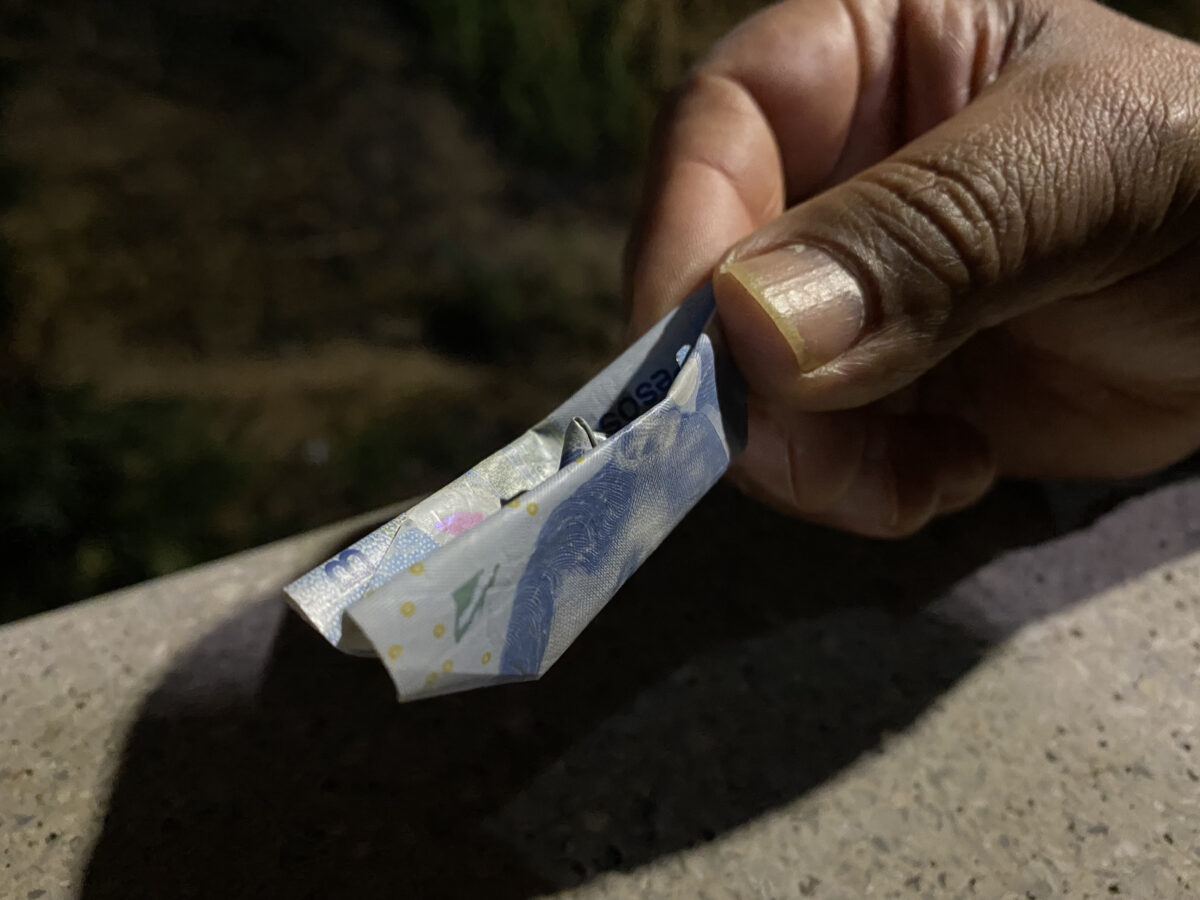
Then, the journalist and artist Jesus Iberrí, who is working to save a canalized river in Oaxaca, takes us to the only accessible section of that river, which otherwise flows underground through the city. From the bridge, he asks us to form our own impression of the stinking water. While explaining who was responsible for the pollution, he folds “our” banknote calmly into a small paper boat. He places it on the bridge railing and looks at us. “Greed for money,” he says, “is what causes people to destroy the environment, the land, the rivers. But perhaps the person who retrieves this little boat somewhere downstream can give the world a new course.” Then he gives the money-boat a gentle push, and it falls hopefully into the river.