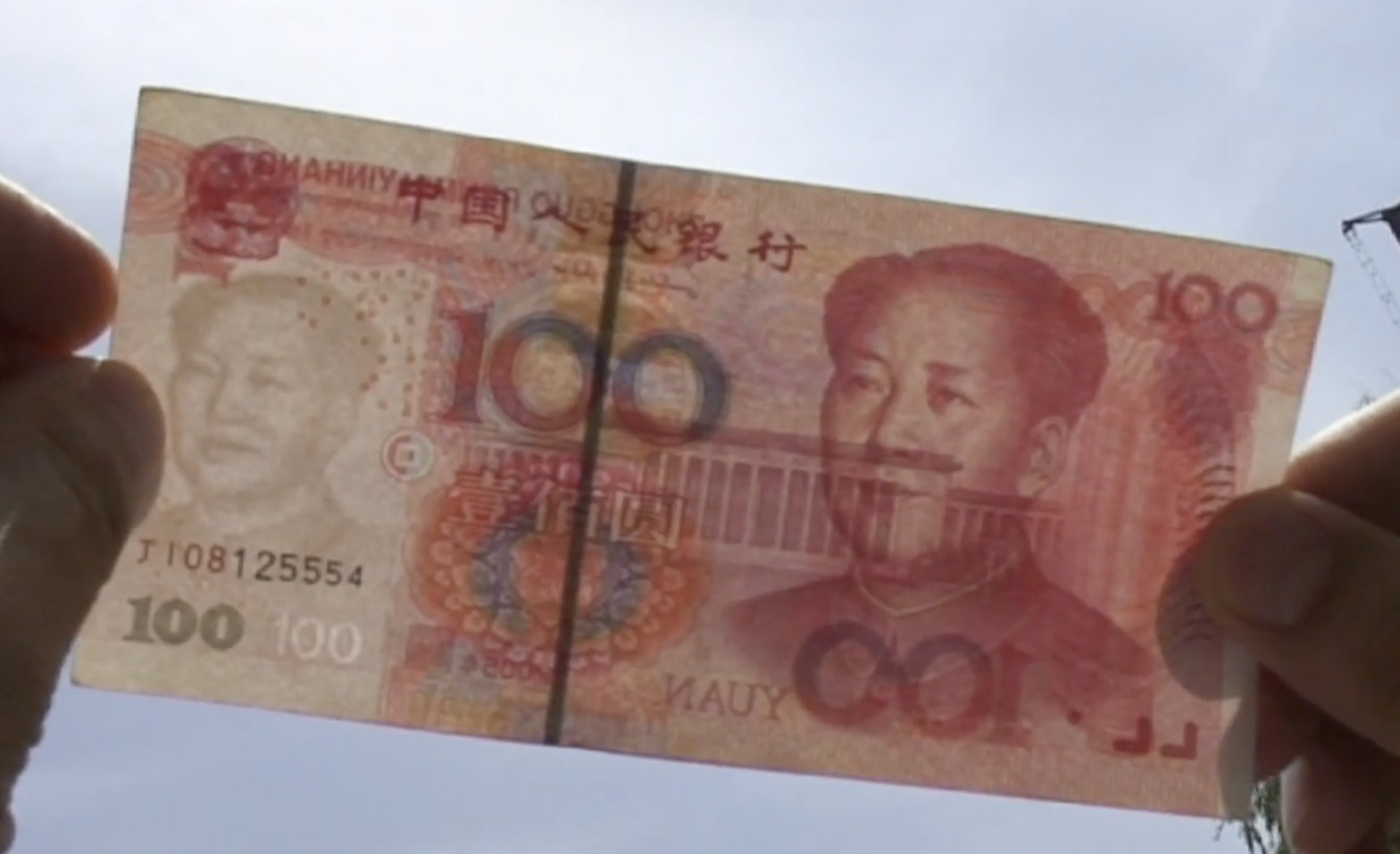
While researching our money project in May 2008 in Beijing, we have come across the Swiss banknote designer Roger Pfund who happened to be in China at the same time. He happily indulged to speak about the design of the 100 yuan banknote.
Roger Pfund, the Swiss illustrator and banknote designer with a speaking name, enjoys the anonymity of cash. No one can track what he does with his money, he says in a conversation on the summer overheated terrace of the Hilton Beijing in May 2008. We sit at a table, in front of us one, then two, then three bottles of well-chilled, wonderful white wine. Roger Pfund is currently in Beijing to open an exhibition of his work. In addition to graphic designs of stocks and banknotes, he is also exhibiting a brand new Fiat, which he is painting with car paint in generous strokes. The car is to be auctioned off in a benefit event to help the victims of the Sechuan earthquake. He also meets with officials from the Chinese Ministry of the Interior, who want to commission him to design a new passport for China. He has already designed the Swiss passport and, as the designer, his name appears on every Swiss identity document. In this way, every Swiss person can also identify a little with Roger Pound, as a badge of good design taste.
Roger Pfund, a multi-talented and active designer, and his design team took part in the competition for the design of the Euro, which was ultimately won by the Austrian Robert Kalina with a faceless design that complies with the specification and shows bridges and facades in their respective stylistic epochs. Roger Pfund makes no secret of the fact that he does not care much for this design. Money, he says, is a task that carries the weight of the state, and the state that spends it must also face up to this in terms of design and representation. Just as Pound had decorated the French 50 franc banknote issued before the introduction of the euro with Antoine Saint-Exupery, he also wanted to depict important European personalities on the euro bills. In the years that followed, he succeeded in doing so, at least for the new issues in Argentina: the Argentine 100 peso bill is emblazoned with the portrait of Evita Peron – in Roger Pfund’s design.